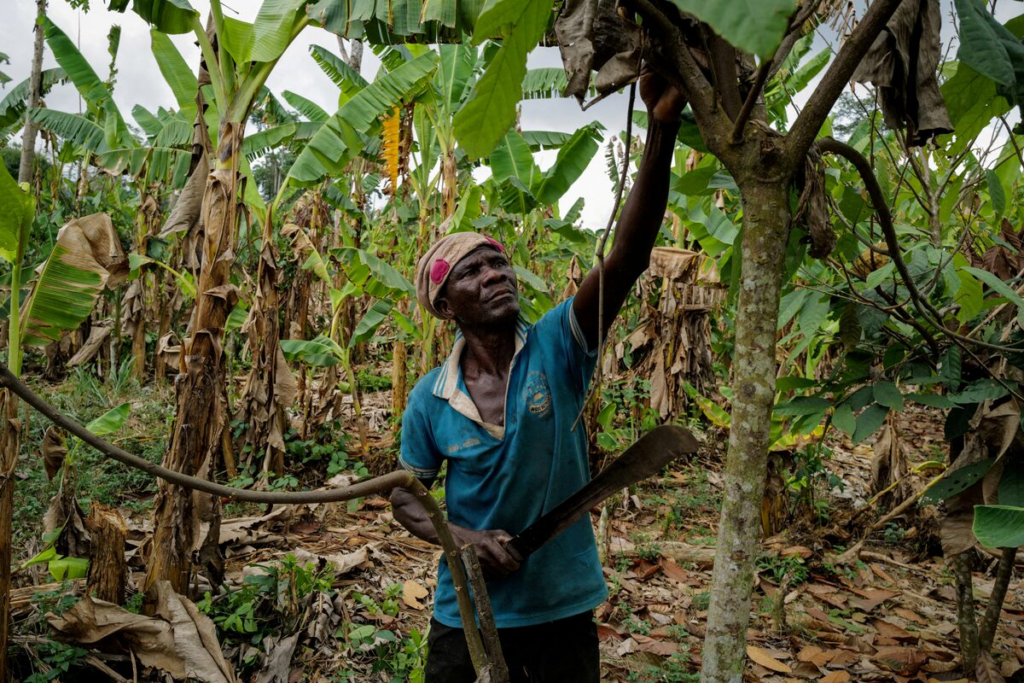
West Africa’s cocoa industry is facing a major compliance challenge as farmers and exporters race to meet new European Union rules aimed at preventing commodities linked to deforestation from entering the European market.
The pressure is particularly serious for Nigeria, where industry experts estimate that farmers producing more than half of the country’s cocoa could initially fail to meet the requirements when the EU rules take effect at the end of December.
Nigeria is the world’s fourth-largest cocoa producer, with about 300,000 mostly small-scale farmers, according to the Nigerian Export Promotion Council. Many of these farmers still need their farms mapped and geographically identified to prove that their cocoa was not produced on land linked to deforestation.
One farmer in Ondo State, Ojo Ayaninuola, initially resisted efforts by exporters to map and geolocate his farm. He later agreed after Sunbeth Global, the exporter that buys his cocoa, warned that failure to comply could put his access to the lucrative European market at risk.
The challenge extends beyond Nigeria. Similar difficulties are being reported across West Africa, including in Côte d’Ivoire, the world’s leading cocoa producer.
The region is responsible for about 70 per cent of global cocoa production and sends roughly two-thirds of its beans to the European Union, meaning any disruption caused by the new requirements could have significant consequences for farmers, exporters and European chocolate manufacturers.
The EU market is particularly important because the bloc accounts for about 60 per cent of global cocoa purchases. As a result, exporters are under pressure to establish reliable systems for tracing cocoa from farms to buyers and proving that production complies with the anti-deforestation requirements.
Industry experts expect cocoa that meets the European requirements to command a premium because compliant supplies could become scarce. At the same time, exporters and farmers who cannot provide the required information risk losing access to one of the world’s most important cocoa markets.
The situation could therefore create a two-tier cocoa market in West Africa, with properly documented beans attracting stronger demand and potentially higher prices while farmers unable to meet the new requirements face difficulties finding buyers.
For Nigeria and other major cocoa-producing countries in the region, the looming deadline has turned farm mapping and traceability into an urgent issue, with the ability to comply with the EU rules increasingly becoming a condition for maintaining access to a market that remains critical to the region’s cocoa trade.