By Wellington Jopelo
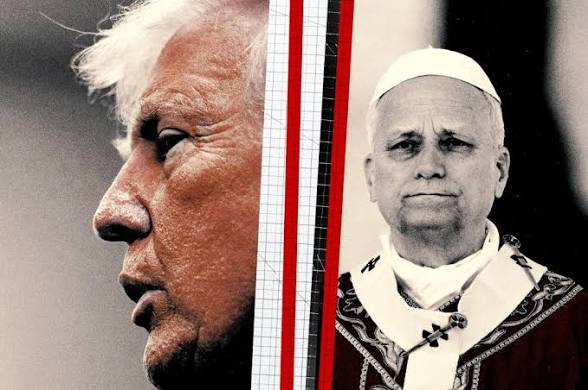
Tensions between former U.S. President Donald Trump and Pope Leo XIV have grown into one of the most talked-about political and religious disputes in recent years, marked by sharp public statements and repeated clashes over global issues.
The disagreement traces back to Trump’s early political rise, when he pushed strong immigration policies, including plans to build a border wall. At the time, senior figures within the Catholic Church openly questioned the morality of such policies, setting the stage for future tensions.
Then-Cardinal Leo, before becoming pope, was among those who stressed compassion for migrants and warned against policies that could divide families. His remarks were widely seen as indirect criticism of Trump’s stance.
Trump responded forcefully during campaign rallies and interviews, insisting that national security must come first. He argued that leaders who failed to protect borders were neglecting their duty to citizens.
After Leo’s election as pope, expectations were high that relations might improve. Instead, differences became more visible, especially as Pope Leo XIV began speaking more directly about global inequality, climate responsibility, and the treatment of refugees.
In one widely shared address, the pope called for “bridges, not walls,” a phrase that quickly went viral online. Many interpreted it as a direct swipe at Trump’s long-standing immigration agenda.
Trump reacted on social media, describing the pope’s comments as “misguided” and accusing religious leaders of stepping too far into politics. His posts drew strong reactions from both supporters and critics, further fueling the debate.
The feud intensified during discussions on climate change. Pope Leo XIV repeatedly urged world leaders to take urgent action, while Trump maintained skepticism about international climate agreements, calling them unfair to American interests.
At one point, the pope warned that ignoring environmental issues could have “moral consequences for future generations,” a statement that sparked another wave of responses from Trump’s camp.
Trump fired back in a televised interview, saying that economic growth should not be sacrificed for what he described as “uncertain global policies,” reinforcing the divide between both figures.
Their disagreement also extended to economic justice. Pope Leo XIV emphasized wealth distribution and support for the poor, while Trump defended capitalist policies and tax reforms aimed at boosting business growth.
Social media has played a major role in keeping the feud alive. Trump has repeatedly used his platform to challenge the pope’s views, while Vatican communications have responded more cautiously, often focusing on broader moral principles rather than direct confrontation.
Observers note that despite the tension, both men command massive global followings, making their disagreements highly influential in shaping public opinion across political and religious lines.
In a move that reignited tensions, Donald Trump sparked widespread reactions after sharing a controversial post on his social media platform, Truth Social, where he circulated an image depicting himself in a Christ-like pose. The image, which quickly went viral, showed Trump styled in flowing robes with symbolic lighting, drawing immediate attention from both supporters and critics.
The post was accompanied by a caption in which Trump described himself as a “fighter for truth” and a defender of what he called “real values,” language that many observers interpreted as intentionally provocative. Within hours, screenshots of the image flooded other platforms, amplifying the debate far beyond his immediate followers.
Religious groups and commentators reacted strongly, with some calling the image disrespectful, while others defended it as political satire. The controversy deepened existing divisions, particularly among faith-based communities already following the long-running dispute between Trump and the Vatican.
In response, Pope Leo XIV addressed the issue during a public audience, without directly naming Trump but clearly referencing the incident. He warned against what he described as the “trivialisation of sacred symbols for personal or political gain,” urging leaders to show humility and respect in both words and actions.
The pope’s remarks were later amplified through official Vatican communications, which stressed the importance of preserving the dignity of religious imagery. His message quickly spread online, with many interpreting it as a measured but firm rebuke of Trump’s post.
Trump, however, did not back down. In a follow-up message, he dismissed the criticism, insisting that his post was being “misunderstood on purpose” and accusing opponents of hypocrisy. The exchange further highlighted the deep divide between both figures, keeping their feud at the center of global conversation.
Analysts believe the Trump–Pope Leo XIV dispute reflects a deeper clash between political nationalism and global moral leadership, a divide that continues to shape conversations worldwide.